Volleyball Mental Toughness
Keys to Breaking Bad Habits
The key to developing volleyball mental toughness and changing old habits is becoming aware of what is. Awareness of what is, without judgment, is the best precondition for change.
Discovering the Natural Way of Learning
If you think you are controlled by a bad habit, then you will feel you have to try and break it.
Fighting old habits is what causes the conscientious volleyball player to strain and tighten
unnecessarily.
It is much more difficult to break a habit if there isn't an adequate replacement for it.
For example, if a volleyball player reads in a book that it's best to pass a
deep serve using an overhead hand setting motion, and isn't offered a better
technique for making the play (moving backwards and forearm passing the ball),
it will likely take a great deal of volleyball mental willpower for her to not play the ball with her
hands.
As soon as the player is back in a game situation, you can be sure she will
revert back to using an overhead passing motion because this gave her some sense
of security for when making the play.
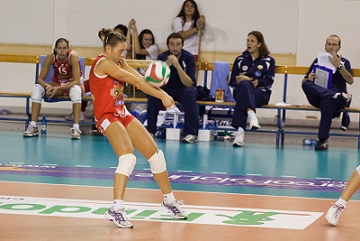
Volleyball Mental Toughness for Passing
Volleyball Mental Training vs Traditional Learning
The following is the traditional way we've been taught to learn.
Step 1. Criticize or judge past behavior.
Examples: I'm passing the ball wrong today. Darn it! Why do I keep
swinging my arms! I'm not doing anything my coach told me to do last
practice. I was a great player, but now I'm playing worse than my little
sister.
(The above is usually delivered in a punitive, belittling tone.)
Step 2. Tell yourself to change, instructing with word commands repeatedly.
Examples: Get your forearm platform out early and contact the ball at
platform level 2. Keep your elbows locked and don't swing your
arms...you stupid bum, you did it again.
Remember to keep your arms stiff and use your legs.
Step 3. Try hard; make yourself do it right.
In this step your mind forces you to use unnecessary body and facial muscles. There is tightness which prevents maximum
fluidity and precision of movement. Your natural capabilities aren't being trusted.
Step 4. Make a critical judgment about results leading to thinking too much and trying too hard.
When trying to perform an action "right", it's difficult not to become either frustrated at failure or anxious about success.
Both emotions are distracting your focus and preventing the experience of what's happening.
Negative judgment results in trying harder.
Positive judgment tends to make you to try harder to force the same pattern the next time.
Both positive and negative thinking inhibit spontaneity.
A Better Way of Learning
Step 1. Observe existing behavior nonjudgmentally.
Examples: On my last 3 of my digs, the ball sailed over the net. Maybe I
should observe the angle of my passing platform. Am I absorbing the
ball? There,
that pass was absorbed better...the ball stayed on our side of the net.
(The above is delivered in an interested, somewhat detached tone.)
Step 2. Picture desired outcome.
No commands are used. Play without judgment and perform in the desired
way to achieve the desired results. If you wish to pass the ball to
the target, simply imagine the necessary path of the ball to the target.
Do not
focus on correcting past errors.
Step 3. Let it Happen.
Having requested your body to perform a requested action, give it the freedom to do it.
The body is trusted, without conscious control of
mind.
The ball seems to pass itself.
Effort is initiated, but there is no trying. Letting it happen doesn't mean you go limp, it means
you only use muscles necessary to do the job.
Nothing is forced.
Continue the process.
Be willing to allow changes within changes, until a natural groove is formed.
Step 4. Nonjudgmental calm observation of the results leading to continuing observation and learning.
Though the player knows her goal, she isn't emotionally involved in
achieving it and is able to watch the results calmly and experience
the process.
By doing this, concentration is at it's highest level and you're learning at the fastest speed.
New changes are only necessary when results don't conform to the image given. Watch it change; don't do the changing.
This process is an incredibly simple one. The important thing is to experience it. Don't intellectualize it. See what it feels like to
ask yourself to do something, and let it happen without any conscious trying.
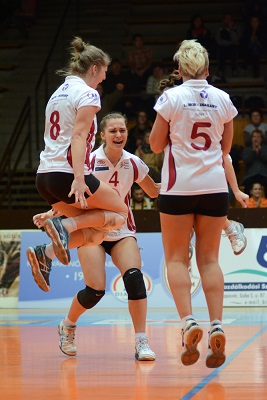
It's Actually a Simple Process
When we stop trying to suppress or correct a habit, we can start to see
the function it serves. We then see an alternative pattern of behavior
emerge quite effortlessly.
Imagine what a child experiences when transitioning from crawling to
walking. When a child first learns to walk, she doesn't have to
break the habit of crawling, because she doesn't think she has a habit.
She simply leaves it as she finds walking an easier way of getting
around.
Experiment with this method and you will discover a workable way to make any desirable change in your volleyball mental game.
If you enjoyed these tips and would like to keep it close to you at any time, just save this pin to your Pinterest Volleyball Training Board.

Volleyball › Coaching Volleyball › Volleyball Mental Toughness


SAY HI ON SOCIAL:




As an Amazon Associate we may earn a commission from qualifying purchases.