Volleyball Basics
Learning How to Play Volleyball
Volleyball basics include learning about volleyball skills and the roles of each player on the team.
Object of the Game
Obviously, you are trying to win. The team that reaches the destination score and has a two point lead, wins the game.
In order to successfully learn how to play volleyball, you must first understand the object of the game.
THE OBJECT OF THE GAME IS TO ATTACK
To help explain what I mean by, "the object of the game is to attack", let me first go over the roles of players on the team.
The different positions on a team are passer, digger, spiker, blocker, server, and setter.
A Simple Explanation of Player Roles
Some players have multiple roles. For example, a libero will likely be responsible for passing and digging.
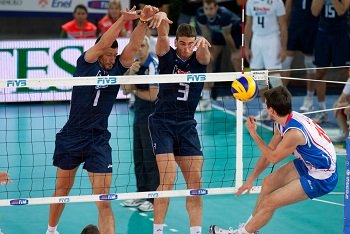
Effective Spiking at the Net is Key
A middle hitter (spiker) could focus on spiking and blocking.
The role of the setter is to set spikers. The setter is also usually the team leader.
Most players have serving responsibilities. In some cases, players from
the
bench might sub into the game and replace the front row players. These
types of
players are usually called DS's (defensive specialists) because they
specialize in coming in the game across the back row to play defense and
pass.
So how does knowing player roles relate to the object of the game....ATTACKING?
The main responsibility of the passer is to pass the ball in a way that makes it easy for the setter to set the spiker.
(The end result we are always looking for is a successful ATTACK.)
The main responsibility of the setter is to set the ball in a way that makes it easy for the spiker to spike
(to execute an effect ATTACK).
The main responsibility of the blocker isn't necessarily to block the
ball, but to block in a way that makes it easier for a teammate to make
a defensive play on the ball.
The diggers main goal is to dig the ball in a way that makes it easy for the setter to set.
(Again, the easier it is to set, the easier it is to ATTACK).
The main responsibility of the server isn't to just serve the ball into
the court or to serve aces. The servers main job is to serve the ball in
a way
so that it makes it easier for the team to block and play defense. The
easier it is to block and play defense, the easier it is for the setter
to set a
spiker and ATTACK the ball.
The reason the "object of the game" is to ATTACK, is because this is ultimately how you want to score points.
(A successful ATTACK is always the end result you're looking for).
For example, you don't score points by digging. You score points by
digging a ball in a way that the setter can get to it and set a spiker
to ATTACK the ball.
If the ball is successfully ATTACKED to the ground, you score the point.
Also, you don't score points by setting a spiker really well. You score because the spiker successfully ATTACKS the ball.
Volleyball Basics to Winning
There are essentially 4 ways to score points...
1. Service Ace. If you score points off of an ace, I would consider this as a successful attack.
2. Kill. A kill is a fancy word for a successful attack.
3. Block. You can score points from successful blocks, but you likely shouldn't depend on blocks to score points.
4. Opponent Error. Scoring points off of opponent errors is definitely common at lower levels of volleyball.
Focusing on making your opponent make errors is good strategy for winning. The
more often you are able to put your team in a position to get a successful attack, the
more often your opponent will make errors.
If you enjoyed these tips and would like to keep it close to you at any time, just save this pin to your Pinterest Volleyball Training Board.

Volleyball Basics Related Pages
Middle School Tryout Tips
Volleyball tryouts for middle school Volleyball tryouts can be intimidating and overwhelming. Knowing the tips and tricks on how to make a great impression.
Volleyball Practice Plan
Volleyball practice plan for creating efficient volleyball practices. How you design your practice depends on many things such as, the level of your team, how skilled your players are, how skilled you are as a coach...
Training Footwork
Footwork in volleyball is critical. Your goal for training footwork should be to get the body to a position that's more effective at performing specific skill...
Topspin Training for Spiking and Serving
Topspin
training and key tips for successful spiking. Focusing on the
pre-contact hand position for spiking with topspin. Do you understand
spin? How to create topspin and the most common mistakes...
Basic Volleyball Coaching
Volleyball
basics, coaching tips, and strategies
for new coaches. Defining your coaching philosophy is important. If you
have a philosophy and your players understand your philosophy, then they
will...
Training for Volleyball
Training
for volleyball. Learn the basics of volleyball training. The difference
between functional training and sport specific training. Training for
speed, strength and power...
Drills for Volleyball
Drills
for volleyball are organized solutions to a problem. Some of the
problems are generic to the sport such as ball control, attack timing,
or footwork. Others are specific to a tactical or systematic...
Beach Volleyball Basics
Beach
volleyball basics and learning the beach game. Playing volleyball in
the sand is different than indoor. For one thing, it's much harder to
move around in the sand...
Setting Volleyball
Setting
volleyball tips. 10 tips that will instantly improve your setting
skills. Leadership, working hard every practice, having a good
relationship with your coach...
Beach Volleyball Setting
Beach
volleyball setting technique is a little different than indoor. Beach
rules for setting are much more strict. Setting the ball without spin is
important. The key is...
Volleyball Court Diagram and Terms
Volleyball
court diagram and court dimensions. The official size of the court,
lines, layout, and diagrams to help explain how to play volleyball. All
the different lines and markings on the court can be confusing...
Basic Rules Volleyball
Volleyball basics to understanding rules that help you get a firm grasp of how to play
volleyball. Some rules are easy to understand while others may initially
have you scratching your head. We take a look at some basic volleyball
rules...
Basic Volleyball Skills
Basic
volleyball skills include serving, passing, setting, spiking, blocking,
and digging. The key to being successful in volleyball is focusing on
fundamentals. Learning strategy is important but developing skills...
Learning Volleyball Skills
Learning
volleyball skills and key tactics to succeeding in volleyball. The
mental side of serving and playing defense. Develop techniques and
become a better blocker, setter, and hitter...
Learn to Play Volleyball
Learn
to play volleyball. Best reasons to play volleyball. Volleyball isn't
an expensive hobby. Competive volleyball isn't as expensive as other
sports. Meet girls and create new friendships...
Basic Volleyball Nutrition
Basic
volleyball nutrition tips. Do you need help deciding what to eat to for
volleyball? How to eat for tournaments, practices, and training
sessions will depend on...
The Secret Formula
Volleyball secret formula for mastering skills and taking your game to the highest level. Learn these tactics for developing fundamentals to win more games...
The Big Secret
Backwards shaping volleyball skills. The quickest and most effective way to develop the fundamental techniques in volleyball. Learn my unique system for....
How to Play
How do you play volleyball? Learn how to play and strategy to be successful. Volleyball rules for beginner volleyball players to help understand the sport.
How to Dig
A dig in volleyball is when a volleyball player makes a defensive play that keeps the ball in play by deflecting the ball in such a way that keeps the ball from contacting the floor.
Volleyball › Volleyball Basics
- Home
- Basics


SAY HI ON SOCIAL:




As an Amazon Associate we may earn a commission from qualifying purchases.