Volleyball Shoulder Strength
Exercise and Injury Prevention
Volleyball shoulder strength is important for performance and preventing injury. The following are tips and exercises to include in your training.
Why is the Volleyball Shoulder Vulnerable to Injury?
Shoulder Mobility and Stability
The shoulder joint is designed for maximum mobility to allow for a wide range of upper body movements to take place. This wide range of mobility comes at the expense of shoulder stability.
Instability of the shoulder joint may also materialize due to the tolerance of the supporting ligaments and weaknesses in the surrounding muscle groups.
The glenohumeral joint (main shoulder joint) is designed to allow a great amount of shoulder mobility, which results in a great potential for shoulder instability.
With such a great potential for instability, it's no wonder the bones and muscles of the shoulder are a commonly injured area.
Discover My Favorite Strength and Power Tool
Improving Shoulder Stability for Volleyball
Push ups may be the answer for improved shoulder function.
By performing exercise variations of the push up, you can improve the function of serratus anterior muscle (an often weak upward rotator).
Push ups on a medicine ball or physioball...
- Performing push ups on an unstable surface increases the involvement of the triceps as a shoulder stabilizer.
- Performing push ups on an unstable surface increases the involvement of the rectus abdominus in stabilizing the body's core.
If you enjoyed these tips and would like to keep it close to you at any time, just save this pin to your Pinterest Volleyball Training Board.
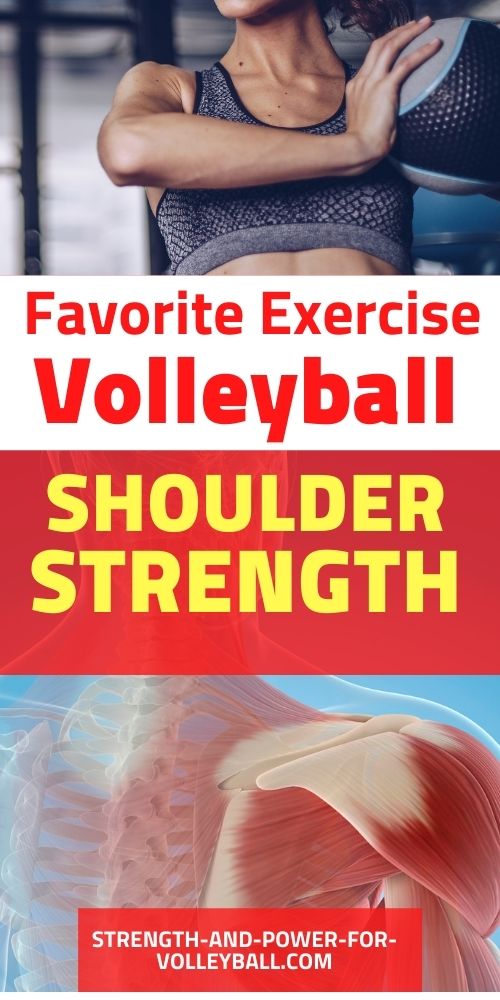
Push up variations train multi-directional stability of the shoulder
Volleyball players need to prepare for the shock that occurs at the shoulder joint from the many swings the hitter makes throughout the season.
Each time a player swings and contacts the volleyball, that's one more repetition that needs to be balance with good shoulder stability.
When designing volleyball training programs, exercises should be considered for preparing for each of those impacts on the shoulder.
Here are some push up variations a player can do to improve stability and volleyball shoulder strength.
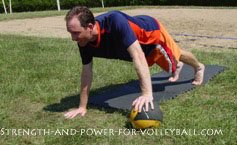
Offset Push Up
Push up variations performed on a medicine ball train mult-directional stability of the shoulder.
-
Purpose:
Improve activation, strength, and stability of the shoulder muscles. -
Starting Position:
Get in a basic push up position (on toes, stomach tight and in a line with upper back and hips) with arms extended at shoulder width. Place the ball underneath your right hand. -
Action:
Slowly lower down your body until your chest is at the same height as the ball. Return to the starting position and repeat for the desired number of repetitions. Switch hands and repeat the exercise. -
Coaching cues:
Vary the speed of movement and number of repetitions depending on your training goals.
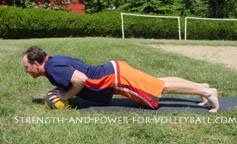
Medicine Ball Tricep Push Up
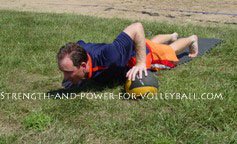
The medicine ball tricep push up works mainly the triceps while also training mult-directional shoulder stability.
-
Purpose:
Improve activation, strength, and stability of the shoulder muscles. Also, increase strength in the chest, triceps, and the trunk muscles. -
Starting Position:
Get in a basic push up position (on toes, stomach tight and in a line with upper back and hips) with arms extended at shoulder width. Place the ball on the ground between your hands. -
Action:
Place both of your hands on top of the ball. Lower your body slowly while keep your body straight. Lower as far as possible. Return to the starting position and repeat the exercise. -
Coaching cues:
Maintain correct body position throughout the movement.
Medicine Ball Walk About
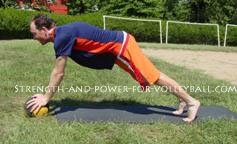
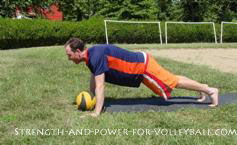
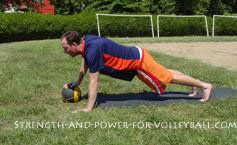
The walk-about trains mult-directional shoulder stability. The advantage
of the walk-about is the movement is more dynamic which results in a
better plyometric effect of training.
-
Purpose:
Improve activation, strength, and stability of the shoulder muscles. -
Starting Position:
Get in a basic push up position (on toes, stomach tight and in a line with upper back and hips) with arms extended at shoulder width. Place the ball underneath your right hand. -
Action:
Shift your weight onto your right hand and then place your left hand onto the ball as well. The ball should now be directly under your chest. Supporting your body weight with your left hand, place your right hand on the ground. Repeat the movement in the opposite direction. Repeat the walking of your hands back and forth for the desired number of repetitions. -
Coaching cues:
Hand touches should be quick to the ground and across the ball for more of a plyometric effect.
Here is the Medicine Ball I Recommend
-
Physioball Push Up Plus
A challenging exercise for shoulder stability and core strength.
Purpose:
Improve activation, strength, and stability of the shoulder muscles. Also, increase strength in the chest, triceps, and the trunk muscles.
Starting Position:
Get in a basic push up position with your hands on the physioball and your fingers pointed out to the sides. Shoulder blades should be pushed away from one another, as far forward as possible.
Action:
Brace your core and lower yourself to where your chest almost touches the ball. Control the ball as you push back up. Try to get as far away from the ball as possible.
Coaching cues:
Keep your body in a straight line throughout the movement.
The medicine ball and physioball push ups may be good exercises to include in volleyball weight training because they provide an unstable surface for training volleyball shoulder strength and stability.
If a player can't perform these exercises correctly, they more than likely don't have adequate stability and volleyball shoulder strength.
Volleyball Shoulder Strength and External Rotation
Athletes who perform repetitive overhead actions are more likely to experience volleyball shoulder injuries.
The rotator cuff muscles must activate to stabilize the head of the humerus in the gluneohumeral joint.
There are 4 rotator cuff muscles...
- supraspinatus
- infraspinatus
- teres minor
- subscapularis
The external rotators (infraspinatus and teres minor) may become weak as a result of the repetitive overhead motion of hitting a volleyball.
The external rotators are used mainly when...
- The arm is being brought back before the hit. During the cocking phase of the volleyball player arm swing, the external rotators are contracting.
- The arm is being slowed down after the hit. During the forward movement of a player arm swing, the external rotators are used eccentrically to slow down the arm, withstanding significant force.
Discover my favorite tool for shoulder stability
Volleyball Shoulder Strength for External Rotation
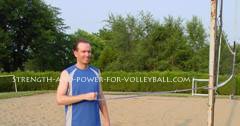
Standing Shoulder External Rotation
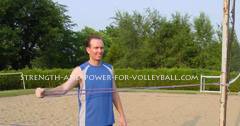
Strengthen the external rotators concentrically using a resistance band.
-
Purpose:
Strengthening the external rotators with external rotation. -
Starting Position:
Grab the resistance tubing of the hand of the shoulder you are strengthening. Flex your elbow to 90 degrees. Position your hand so you are holding the tubing with your thumb pointed up. -
Action:
Externally rotate to 90 degrees by pulling the elastic tubing across your body keeping your elbow flexed to 90 degrees and your upper arm in line with your body. -
Coaching cues:
In this exercise you are basically pulling the band (externally rotating) from the left side of your body to your right (if you are exercising your right shoulder). The exercise should be performed with light resistance completing 1-2 sets of 25-30 repetitions.
Discover my favorite resistance bands
-
Side Lying External Rotation
This exercise is essentially the same as the standing exercise except you're using a weight instead of elastic tubing and you are lying on your side.
Purpose:
Strengthening the external rotators with external rotation.
Starting Position:
Grab a light dumbbell with your hand of the shoulder you are training. Lie on the side opposite the shoulder. Bend your elbow to 90 degrees.
Action:
Externally rotate your shoulder while keeping your elbow bent at 90 degrees and your upper arm resting on your side.
Coaching cues:
The exercise should be performed with light weight completing 1-2 sets of 25-30 repetitions. -
Horizontal Abduction with External Rotation
This exercise is a progression of the standing external rotation and side lying external rotation exercises.
Purpose:
A more challenged exercise for strengthening the external rotators.
Starting Position:
Grab a dumbbell and lie prone (face down) on a table or bench. With your arm straight, move your arm to 90 degrees of horizontal abduction.
Action:
Externally rotate the shoulder.
Coaching cues:
The exercise should be performed with light weight completing 1-2 sets of 25-30 repetitions. -
Shoulder External Rotation 90-90
As the strength of the external rotators gets stronger, strength can be challenged with the arm positioned in elevated positions.
Purpose:
A more challenged exercise for strengthening the external rotators.
Starting Position:
Stand with your shoulder abducted to 90 degrees and elbow flexed to 90 degrees. Start with your shoulder rotated in a neutral position (palm facing down).
Action:
Perform the exercise by externally rotating the shoulder to 90 degrees.
Coaching cues:
Your arm and shoulder should maintain this 90-90 position throughout the movement. -
Eccentric 90-90
As the strength of the external rotators gets stronger, strength can be challenged with the arm positioned in elevated positions.
Purpose:
To train the shoulder external rotators eccentrically to develop strength to help control the speed of internal rotation (strength to help slow down the arm swing after hitting).
Starting Position:
Stand in the same 90-90 position (shoulder rotated to a neutral position, palm facing down).
Action:
Perform the external rotation to 90 degrees. At this position, take a step back. Now, allow the shoulder to slowly internally rotate to the neutral position.
Coaching cues:
The speed of the internal rotation should be slow and controlled.
When designing a training program for the volleyball athlete, it may be necessary to include exercises that strengthen the shoulder's external rotators.
Functional volleyball shoulder strength can be assessed by performing exercises such as push-ups, pull-ups, and rows.
Volleyball Shoulder Strength Related Pages
Functional Strength WorkoutsVolleyball › Workout for Volleyball › Volleyball Shoulder Strength


SAY HI ON SOCIAL:




As an Amazon Associate we may earn a commission from qualifying purchases.