Volleyball Scholarships
How to get a Play College Volleyball
There are many opportunities to earn volleyball scholarships. The following information will help you prepare to get a scholarship for volleyball.
What You Need to Do to Get a College Scholarship
1. You need to play club volleyball. Club volleyball lasts from
November to about May. You can't just play for your school, you need to
play club because the more experience you have the better you'll get.
You'll also get recognized by college coaches if you play club.
Especially if you play on a good club team, the best college coaches
will be recruiting from these teams.
If you're just starting out playing, you should find the best club team in your area and try to make that team. If you are on a real good club team you'll get noticed by college coaches.
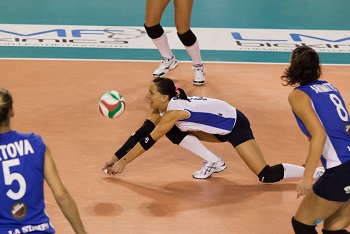
Play Club Volleyball
2. It's also best to play on a winning team. College coaches want
players that are winners. If your team wins all the time, a college
coach is more likely to be interested in you.
3. Visit colleges. By your sophomore and junior year in high
school, you need to be visiting colleges. Many college coaches have
their teams set by your junior year, so don't wait
until it's too late.
4. Make good grades. If your grades are really good, you can get
an academic scholarship to most NAIA schools. NAIA schools will
definitely be more interested in you if your grades are real good.
Most NAIA schools have many volleyball scholarships, (some teams have 2 JVs), so if
your grades are good, you have a good shot of at least playing NAIA if
you're not that great a player.
Excelling in Club Often Leads to Volleyball Scholarships
5. Increase your vertical. College coaches will be very interested
to know how high you can touch. For example,
the average college coach won't even consider a player that can't touch
at least 9 feet 4 inches. For Division I volleyball, college coaches
want players that can touch at least 9 feet 10 inches.
Some higher level Division I schools require players to touch 10 feet.
For NAIA, you probably need to touch at least 9 feet 6 inches.
This is just for front row players. If you're a libero or DS, coaches won't care
so much how high you touch. If you are a setter, how high you touch can be important if
as a setter you play on the front row.
6. Be tall. If you're taller than most, you'll get noticed. If you're 5
feet 10 inches or taller, you'll have a good shot at playing in college as an
outside, right side, or middle hitter. If you're under 5 feet 10 inches, you
better have good skills. If you're 5 feet 6 to 5 feet 9 inches,
you could possibly play at a lower level college as an outside. If you're this
small, you must jump real well and have really good fundamental skills. If your
position is libero or DS, height isn't going to matter so much. However, some
coaches do prefer taller defensive players.
Train Hard and Jump Higher
For NAIA or junior college volleyball scholarships, height of setters doesn't matter so much. Most NAIA volleyball teams run a 6-2 offense because of unlimited subs. The strategy for NAIA is usually to run a 6-2 and play the setters across the back row and then sub them out across the front for taller front row players. Division I coaches will want a taller setter, especially if they run a 5-1.
Tall and Athletic Players Have a Big Advantage
7. Train for strength and explosive power, not aerobic endurance.
Most kids and inexperienced club coaches make the mistake of training
for endurance and not explosive power. For example, running long
distances for conditioning is a waste of time. For volleyball, you want
to be quick and explosive.
Training should involve going hard for short periods of time with rest
in between the hard efforts. For example, sprint for 30 seconds then
rest for a minute. Then sprint again for 30 seconds and rest for a
minute. Keep doing this for 15 or 20 minutes. This is the way you want
to condition.
Also, you don't want to just do sprints. You need to have agility and
quick change of direction movements in your training. Volleyball, just
like most sports involves moving quickly, then changing directions
quickly.
For example, you need to move quickly to get in position to pass. Of if
you're a setter, you need to move quickly to where the ball is passed
and get in position to set. Or if you're blocking, you need to change
directions quickly to move laterally along the net to get in position to
block. Being good at volleyball is all about having the ability to
quickly get in position to make the play. Training to improve your
ability to quickly change directions, stop and be ready to make the play
is very important.
Be sure to download my volleyball strength and conditioning program if you haven't already.
8. High intensity strength training. You want to strength train
using heavier loads and fewer repetitions. For example, if you were to
lift lighter with less rest between sets, you would be training more for
muscular endurance and less for strength and power.
You want to focus more on strength and power and less on muscular
endurance because you want to be able to move quickly and powerfully to
pass, make defensive plays, jump to block, explode quickly when
approaching to hit, spiking hard with a lot of power, etc.
Develop Strength and Power for Volleyball
9. Always warm up by doing dynamic movements, not static stretching. When you warm up, you want to wake up your nervous system by doing dynamic movements such as skips, hops, lunges, high knees, high heels, etc. These types of movements wake up your muscles. You don't want to do static stretches because holding a stretch relaxes your muscles, basically puts them to sleep and puts you at risk for injury. You want to be explosive when you play volleyball, so it's important to warm up properly, preparing your body to move.
If you enjoyed these tips and would like to keep it close to you at any time, just save this pin to your Pinterest Volleyball Training Board.
Volleyball › How to Play Volleyball › Volleyball Scholarships


SAY HI ON SOCIAL:




As an Amazon Associate we may earn a commission from qualifying purchases.