Blocking Volleyball Tips
Blocking volleyball keys are positioning, timing, and movement.
To be an effective blocker, you need to stay in a balance position ready to anticipate.
Good blocking volleyball skills consists of moving into good position to
jump up and penetrate the net with your hands and arms to deflect or
block your opponents attack.
Ready position for blocking...
- Stand at a comfortable distance off the net. You should be standing with enough leverage to push off and move sideways if you need to.
- Place your arms up in front of you. You want your arms up ready to react to the other teams offense.
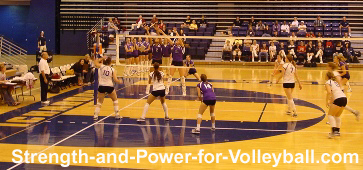
Blocking Volleyball Tips for Better Footwork
Keep hands up and feet ready to moveYou want your hands up rather than at your sides so that you can quickly get them above the net to block. Also, by having your hands up you are less likely to brush your hands with the net as you jump up.
Two step lateral
To perform this move, you basically start by
jumping laterally off of one foot. To move to the left, take a big step
(or jump) to your left foot. Follow with your right foot, land, and jump
straight up.
Two important points...
- You want to jump lined up in front of where the hitter will be contacting the ball.
- You want to make sure you are balanced before you jump.
Three step crossover
This is to travel a greater distance
sideways at the net. To move left, take a step with your left foot, then
cross your right foot over in front of your body (your body is now
sideways). After you have planted the right foot, turn and face the net.
Jump straight up to block.
Blocking Volleyball Tips for More Effective Blocking
Practicing blocking is often left out of practice. Players often are left with great potential for improvement. Teams can take over a match with good blocking much like a good server can with their serving.
Court vision
Know both the setters and hitters tendencies
ahead of time. Watch the setter and hitters for clues as to where the
setter is going to set and how the attackers are going to approach to
hit.
Dont swing your arms
When raising your hands above the net,
don't swing your arms towards the net. This will make timing the block
even harder. It is also more likely the ball will be hit off of you
because your arms may not be in the right place.
Hands position
Your fingers should be spread as wide as
possible when blocking. By spreading them wide you cover more area and
help tense them up which makes them stronger for blocking. Strong tense
fingers prevents jamming or injuring your fingers during blocking.
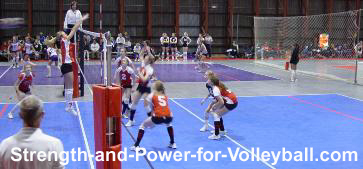
Always penetrate the net
Don't try reaching high to block.
Instead, make your opponents hit over you. If they try to hit over you
they won't do it consistently. The more you penetrate the less of an
angle hitters will have to hit around you. Also, the more you block the
ball on your opponent's side of the net, the more likely the ball will
come down on their side.
Blocking Volleyball Tips for Effective Communication
Teams that have good passing skills will often try to execute a quick offense. It's important for blockers to communicate their blocking responsibilities before the serve.
Identifying the front row players and setter
As a blocker, you need to know who the possible hitters are. You also need to know if the setter is front row or back row.
A good setter can often draw blockers to them, making the blockers think they need to defend the setter's attack. If you know ahead of time where the setter is on the court (front row or back row) you will know when you need to be prepared to defend a setter attack, and when to ignore the setter and stay with the attackers.
Often a team designates one of the front players as the blocking captain (usually the middle blocker) to facilitate communication.
Call out your opposition
Blockers should develop volleyball skills for identify the opposing
setter as front row or back row and also identify the opposing hitters
by making calls before the serve.
Examples of call outs by blockers before the serve are...
- 3 hitters, setter down
- 2 hitters, setter up
- 3 hitters, stack right
-
3 hitters, stack left
Also, you can call out numbers...
- 3 hitters...stack right...4, 7, and 13
- setter up...5...2 hitters..4 and 7
Calling out the setter and hitter's is an effective blocking strategy that will better prepare your team for playing defense. Effective communication skills are the volleyball skills that often separate the best teams from everyone else.
If you enjoyed these tips and would like to keep it close to you at any time, just save this pin to your Pinterest Volleyball Training Board.
Volleyball › Volleyball Techniques › Blocking Volleyball Tips


SAY HI ON SOCIAL:




As an Amazon Associate we may earn a commission from qualifying purchases.