Volleyball Passing Tips
Strategies for Serve Receive
Use volleyball passing tips to improve your serve reception.
Passing techniques for serve receive involve passing the ball in such a way that the setter will have time to get there to set any of the available attackers.
In a match of evenly matched teams, the team that passes serves more accurately, often will win. Strategies for passing play an important role to team success.
Get in position early
Every player should be ready to react and move to the ball. The sooner a volleyball passer is able to make a good judgment on the ball, the easier it will be to pass.
Making good volleyball passes is all about making good judgments and communicating with your teammates.
Height of the pass
To run a quick offense, the pass should go no higher than the top of the antennae. Passing to the same height will allow a team to develop a rhythm to their offense.
This will also force the opponents to react quicker to prepare to defend the attack hit.
A less skilled team may need to pass higher to allow their setter time to get to the ball.
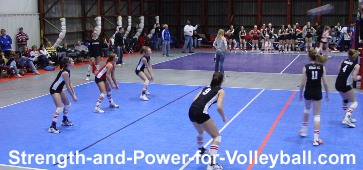
Volleyball Passing Tips for Communication
Communicating before serve
Establish ahead of time who your primary passers are going to be for that particular rotation.
Decide who is going to call the ball and what teammates are going to help calling the ball "in" or "out".
The whole team should be watching the server and be ready to move.
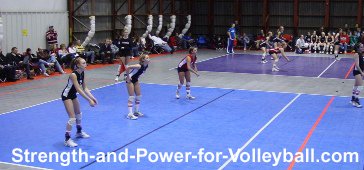
Communicating during serve
Players should make calls to one another such as "in", "out", "play it", "me", or "mine" as the ball is coming across the court.
It's best to call the ball loud at least 3 times quickly. Mine! Mine! Mine!
When calling the ball for your passer, it may be easier for teammates to not make an "in" or "out" call on balls they are unsure of.
If the ball is yours and your teammates don't make a call, then play the ball, unless of course you think it's out.
It's best to make calls to one another as soon as you can read the serve.
Volleyball Passing Tips for Anticipation
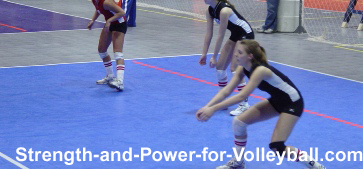
Stable staggered ready position
It is best to be in a ready position for quick starts and quick stops. Knees should be flexed enough to spring in any direction, yet not too much to take away from your agility.
Weight is on the balls of the feet with one foot slightly in front of the other in a balanced stance leaning forward.
Expect the Ball to Be Yours
Focus on the ball and expect to be the one that plays the ball. Players should focus on their opponents and adjust their court positioning every time their opponents touch the ball.
Once movement habits improve, coaches can train their players at faster speeds than a normal game tempo. It's important to train at faster speeds improves player ability to anticipate and meet the ball earlier.
Anticipate the need to pursue a ball
The whole team, especially backrow defensive players, should track the trajectory of the ball, after every opponent contact, anticipating having to move to play the ball.
When pursuing the ball, if a player can't get there early enough to stop and get in position, she should do a run through technique for playing the ball.
Sometimes you may get a bad read on a ball. In these instances, it may be necessary to perform defensive techniques such as sprawls and pancakes.
Being off balance in anticipation
It's important to train being off-balance and leaning in the right direction early.
The reason this may be better than being in a balanced position is because the player is going to get in that off-balance position anyway when they take the first step in anticipation.
For example, leaning forward in anticipation of a ball dropping in front of you gives you more time to get there to play the ball.
Anticipate the Ball Coming to Your Way
Read the Server
Watching the server is critical to getting a good read on the ball.
By paying attention to where the server is standing and watching their toss, you can predict where they are going to serve. Servers often like to serve the same spots every time they go back to serve.
Be aware of what serving strategies a server has used in the past to help anticipate what serve may be coming.
Get a good read on the three most popular types of serves...
- The float serve
Players that have good float serves may toss the ball fairly low. The server usually tosses low then hits the ball with a nice firm quick contact. - The spot serve
When serving spots, getting the ball to float isn't usually a big concern, so the toss and contact may not be as important to the server. Teams that try to serve short are often easier to read. The server usually stands closer to the end line. The contact of the ball is usually higher and a little farther back (directly above or slightly behind the servers head). The flight of the ball is usually a higher arc in order to get the ball to drop short over the net.When serving deep, the contact of the ball may be more in front the server. The ball is usually served quicker and harder. - The jump serve
When watching a jump server, you can pick up a lot of info from their approach and toss. Jump servers that have inconsistent timing are easier to read.If the toss is too low and they are late getting there to hit, the serve usually goes low and short.If the toss is too high or they approach early, the serve usually goes up and deep.
Volleyball Passing Tips for Playing the Ball
Cushion hard driven balls
Passers can use the technique of relaxing the shoulders to absorb the contact of hard driven balls. You can even slowly take steps back and lean backwards to help absorb contact.
Whether you prefer to pass with your forearms or hands, all players should developing various skills for passing. Often players will have to react at the last second and quickly decide how they are going to play the ball.
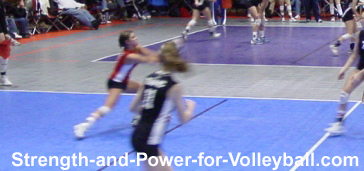
Passing the seams
Deciding on who passes balls served between two players can be difficult.
Passing "the between ball" can be broken down into two parts.
- The short seam pass
The volleyball passer closest to the server is responsible for passing the short ball between the two players. - The deep seam pass
The passer farther away from the server is responsible for the ball served deep between the two players.
Volleyball passing tips for seam passing are particularly important for teams using 2 or 3 person serve receive patterns.
If you enjoyed these tips and would like to keep it close to you at any time, just save this pin to your Pinterest Volleyball Training Board.
Volleyball Passing Tips Related Pages
Volleyball › Volleyball Strategies › Volleyball Passing Tips


SAY HI ON SOCIAL:




As an Amazon Associate we may earn a commission from qualifying purchases.